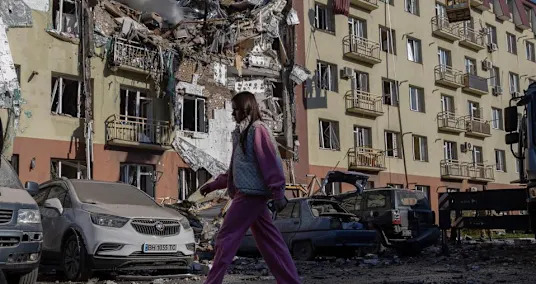
Dispatches from Ukraine. Day 1,504.
Ukraine Outpaces Russia In Drone Launches
For the first time since Russia launched its full-scale invasion in 2022 and began to pummel Ukraine with near daily aerial attacks, Ukraine appears to have launched more drones in a single month than the Kremlin, according to an ABC News analysis of official data from both sides.
The figures come with caveats, as neither side’s claims can be independently verified, and both Kyiv and Moscow have an incentive to either overstate interception rates or amplify incoming threats to shape the narrative about their air defense effectiveness amid stalled peace efforts due to the Iranian war.
Even so, Russia’s Defense Ministry reported shooting down 7,347 Ukrainian drones in March, a record monthly figure that, if correct, translates to an average of 237 drones per day. Importantly, Russia has generally played down the impact of Ukrainian strikes, often portraying them as failed and reporting "insignificant" damage from falling debris of drones. Moscow publishes only the number of drones it claims to have intercepted (not the total number of units launched). This likely indicates that Russia may underreport the full scale of Ukrainian strikes.
The Ukrainian Air Force has been less secretive in reporting statistics, disclosing the number of un-intercepted projectiles. Ukraine reported facing 6,462 Russian drones and 138 missiles last month, or 208 projectiles per day; of those, 5,833 drones and 102 missiles were intercepted, yielding a 90% interception rate for drones and close to 75% for missiles.
Long-range strikes have become an integral part of both sides’ war strategies, intended not merely to hit targets, but to sap economic resilience and stretch the enemy’s air defenses. Ukraine has focused its drone campaign on Russia’s military and oil refineries, seeking to tear apart the sinews of Moscow’s war machine; meanwhile Russia, in addition to consistently striking civilian buildings, has targeted power plants, inflicting heavy damage on Ukraine’s energy system and forcing rolling blackouts for businesses and households as recently as this winter, the coldest in more than a decade; such outages have recurred throughout the war, yet Ukraine has managed to lick its wounds and piece its energy infrastructure back together.
Recognizing the growing importance of aerial warfare, President Volodymyr Zelenskyy has hailed the rapid expansion of Ukraine’s defense industry. In October, he said that Ukraine’s production potential “for drones and missiles alone will reach $35 billion” by 2026, though he did not specify whether these capacities would be fully contracted by the state, as Kyiv faces a budget crunch and domestic arms makers deal with export restrictions and patchy government orders. The Ukrainian leader also noted that Ukrainians are creating a defense product that, in certain parameters, already "surpasses many others in the world.”
Missile development is also advancing in Ukraine. Ukraine’s “Flamingo” cruise missile, reportedly capable of traveling more than 1,800 miles, promises to help fill a gap in longer-range capabilities. However, drones remain the workhorse of the campaign.
Ukraine’s long-range campaign is now morphing into a tool of economic coercion. Russia, buoyed by higher global oil prices due to the war in Iran, has reaped significant revenues from energy exports. At the same time, Kyiv has increased its drone strikes on Russia’s oil infrastructure and export terminals to chip away at one of the main pillars of the Kremlin’s income.
The geography of Ukrainian strikes is expanding, and with it, their ambition. Russian Ports such as Primorsk and Ust-Luga (both 80 miles from Saint Petersburg, Russia's second biggest city) have been repeatedly targeted. These ports together account for more than 40% of Russia’s seaborne crude exports.
Ukrainian drones have also struck deep inside Russia, hitting industrial facilities in Ufa, some 1,100 miles from Ukraine, including assets belonging to the oil companies Rosneft and Bashneft. Satellite imaging cited by Bloomberg indicate fires at multiple oil processing sites with a combined capacity of roughly 470,000 barrels per day.
The financial toll for Russia is becoming harder to absorb, as Ukrainian attacks pinch revenue streams. According to estimates by the Kyiv School of Economics, five recent attacks by Ukraine on Primorsk and Ust-Luga have resulted in close to $1 billion in lost revenues for Russia in a single week in March. Although Russia can resume its shipments within days, the damage to its storage tanks and infrastructure may take months to repair, creating bottlenecks in global energy markets.
By Danylo Nosov, Karina L. Tahiliani
This article was originally published on Forbes.com
LATEST POSTS
- 1
 Tanzania president remorseful over internet shutdown on election day
 - 2Auschwitz Committee wants German auction of Holocaust items scrapped
- 3What Yogurt Types Do You Know
- 4Game theory explains why reasonable parents make vaccine choices that fuel outbreaks
- 510 High priority Contraptions for Tech Aficionados


- Turning into a Distributed Writer: My Composing Process
- Well known SUVs With Low Energy Utilization In 2024
- Tehran synagogue damaged by missile strike according to Iranian media
- San Francisco sues 10 companies that make ultraprocessed food
- One third of Spanish pork export certificates blocked since swine fever outbreak, minister says
- At least 490 protesters killed in Iran, activists say
- A rare whale is having an encouraging season for births. Scientists warn it might still go extinct
- Nearly 16,000 New York City nurses prepare to strike as contract talks stall
- Find the Advantages of Positive Nurturing: Supporting Cheerful and Sound Kids