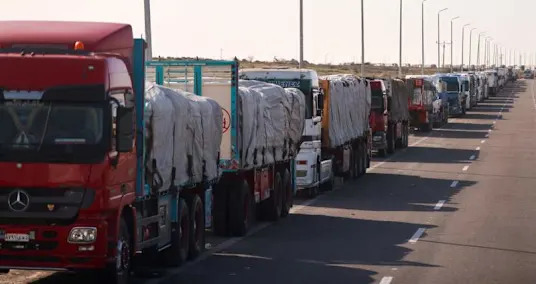
Two IDF officers and a civilian face indictments for smuggling contraband into Gaza using humanitarian aid trucks, part of a growing wartime smuggling investigation.
Military and civilian prosecutors on Tuesday filed prosecutors’ declarations ahead of indictments against two IDF officers and a civilian suspected of exploiting humanitarian aid trucks to smuggle prohibited goods into the Gaza Strip for profit, in the latest in a growing wartime cluster of Gaza-smuggling cases. According to the joint statement by the Shin Bet (Israel Security Agency), Israel Police, and the IDF, the suspects are accused of trying to move contraband into Gaza in exchange for hundreds of thousands of shekels.
Investigators allege that Nasser Abu Mustafa, a resident of Rahat, used his ties to an IDF reservist officer to examine the possibility of carrying out smuggling operations into the enclave. After the two allegedly formulated the plan, the reservist is suspected of bringing in a second officer.
IDF officers exploited their military positions
Authorities say the officers exploited their military positions and access to information about aid convoys, while Abu Mustafa hid the prohibited goods inside trucks that had broken down on the way to Gaza after arriving under the guise of repairing them. The contraband allegedly included hundreds of thousands of cigarettes and several cellular devices. Prosecutors said indictments are expected to be filed soon.
The case adds to an expanding body of wartime prosecutions centered on the movement of goods into Gaza. In February, prosecutors filed indictments against 12 Israelis accused of helping smuggle millions of shekels’ worth of goods into the Strip during the war, including cigarettes, mobile phones, batteries, vehicle parts, communication cables and electrical equipment, in a scheme prosecutors said strengthened Hamas economically.
In March, prosecutors filed another indictment against four defendants accused of repeatedly attempting to move prohibited goods into Gaza outside the authorized inspection and transfer mechanism, including cigarettes, cellphones, solar panels, batteries, generators, and computers.

This affair, based on the material now public, does not appear to be part of the recent Iran-linked espionage investigations.
Still, it emerges against a broader wartime backdrop in which Israeli security agencies have been dealing at once with two separate patterns: internal smuggling cases involving alleged profiteering through Gaza supply routes, and a distinct wave of Iran-linked espionage probes involving Israelis suspected of carrying out tasks for Iranian actors. Just this week, limited publication was allowed in a separate security case involving suspects alleged to have provided services to Iranian elements, including suspected work connected to explosive material.
LATEST POSTS
- 1
 FDA adds strongest warning to Sarepta gene therapy linked to 2 patient deaths
 - 2Exhaustive Experiences into Prudent Senior Living in the UK
- 3Indian rocket launches record-breaking BlueBird 6 smartphone satellite to orbit (video)
- 4ABC News' Sam Champion opens up about recent health scare
- 5NASA's Artemis 2 pilot Victor Glover listens to 'Whitey on the Moon' every Monday. This is why.




- Careful Living: Embracing the Current Second
- Nodding off is dangerous. Some animals have evolved extreme ways to sleep in precarious environments
- Kiefer Sutherland arrested after allegedly assaulting a ride-share driver in L.A.
- Figure out How to Reveal Stowed away Open Record Rewards
- RSF attack on Sudan’s South Kordofan kills at least 14, including children
- Watch live as near-Earth asteroid Eros buzzes the Andromeda Galaxy on Nov. 30 (video)
- The Most Moving TED Talks You Want to Watch
- ‘Wicked: For Good’ streaming release — How to watch the sequel starring Ariana Grande and Cynthia Erivo
- Vote in favor of your Number one Sort of Cap