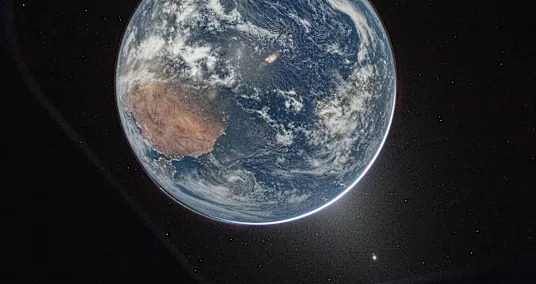
NASA has released the first images taken by the Artemis II crew during their historic trip around the far side of the moon.
The four astronauts — NASA commander Reid Wiseman, pilot Victor Glover, mission specialist Christina Koch and Canadian Space Agency mission specialist Jeremy Hansen — spent Monday’s seven-hour lunar flyby taking photos and making observations from the Orion spacecraft, which they named Integrity.
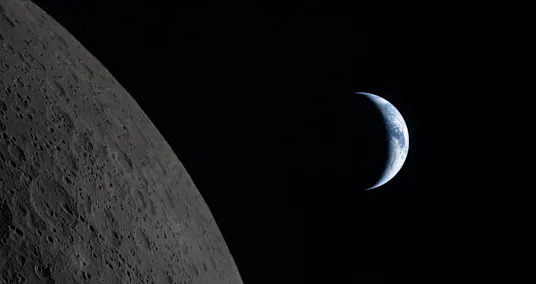
Among the stunning new images uploaded by NASA on Tuesday was a photo of “Earthset,” which was captured through the Orion capsule’s window at 6:41 p.m. ET, according to NASA.
"A muted blue Earth with bright white clouds sets behind the cratered lunar surface," the photo caption reads. "The dark portion of Earth is experiencing nighttime. On Earth’s day side, swirling clouds are visible over the Australia and Oceania region.”
Visible in the foreground is the moon, with the Ohm crater’s “terraced edges and a flat floor interrupted by central peaks,” per NASA’s description.

The crew also captured “Earthrise,” recreating the iconic photo taken during the Apollo 8 mission in 1968.

Also included in the new batch of images is a view of the solar eclipse that the crew experienced near the end of the flyby.

The astronauts donned eclipse viewers to protect their eyes during the nearly hour-long celestial event. But they still struggled to put into words what they were witnessing.

“Humans probably have not evolved to see what we're seeing," Glover told mission control. "It is truly hard to describe.”

Other photos captured close-up views of the lunar surface, including little-seen craters and basins from the vantage point of the crew, which at one point came within about 4,000 miles of the moon.
During Monday’s flyby, the Artemis II set a new record for the farthest distance from Earth traveled by humans — 252,756 miles, surpassing the previous mark set by Apollo 13 in 1970.


LATEST POSTS
- 1
 7 Methods for further developing Rest Quality
 - 2Birds Will Flock To Your Birdbath When You Plant These Two Flowers Around It
- 3Jamie Dimon warns Iran war could drive inflation, interest rates higher
- 4Unwinding History's Secrets: Looking for the Response to Antiquated Human advancements
- 5Change Your Physical make-up: Compelling Activities for Muscle Building





- Figure out How to Explore the Infotainment Framework in the Slam 1500.
- Toyota Just Electrified a Pickup Legend, but It Won’t Be Cheap
- Where America’s CO2 emissions come from – what you need to know, in charts
- Germany records first wolf bite on human since repopulation
- Hamas hands over another body in the Gaza Strip
- Artemis II's moon-bound astronauts capture Earth's brilliant blue beauty as they leave it behind
- India’s delayed climate plan sets modest emission target
- Trump awarded 1st FIFA Peace Prize by Gianni Infantino at 2026 World Cup draw
- Meet Beef the bulldog, who takes slow walks with his 78-year-old friend