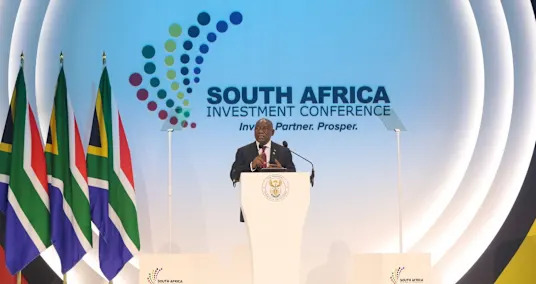
South African President Cyril Ramaphosa launched a nearly $200 billion investment drive aimed at accelerating economic recovery and industrialization in the face of growing worry over the impact of the Iran war on the continent’s biggest economy.
For more than a decade, South Africa’s economy has barely grown, leaving it with crumbling infrastructure and the need to create jobs in a country where one in three people are unemployed. Ramaphosa’s pitch to investors in Johannesburg this week was that South Africa has fixed the worst bottlenecks: He said the country is opening key sectors to private capital and is ready for large scale investments.
Ramaphosa said the effort will run through 2030 with delegates at the South African Investment Conference pledging $53 billion across 31 projects spanning energy, logistics, manufacturing, and digital infrastructure. They include Coca-Cola’s $1 billion expansion plan, and a $3.6 billion commitment from Sasol — the world’s biggest maker of fuel from coal — to upgrade operations.
LATEST POSTS
- 1
 Famous Kitchen Finishing Styles For 2024
 - 2Find Serenity: 10 Stunning Setting up camp Areas
- 3Brazil passes anti-gang law allowing seized crypto to fund security forces
- 4Colombia's military rescues 6 siblings who hid in the rainforest to escape from a rebel group
- 5Newly discovered link between traumatic brain injury in children and epigenetic changes could help personalize treatment for recovering kids




- The Best Computer games Ever
- Scientists find twisting magnetic waves on the sun. Could this help solve a huge solar mystery?
- Scientists dove hundreds of feet into the ocean and found creatures no human has ever seen. Our trash beat us there
- A Manual for Nations to Head out To
- Launch pad damaged as Russian rocket blasts off for space station, agency says
- Figure out How to Reveal Stowed away Open Record Rewards
- Claim that Israel opened 'sewage dam' into Gaza's main river undersells sanitation crisis
- 4K televisions for Extreme Film Watching Experience
- Holden Commodore Turbo BT1 Police Interceptor Offered for Sale in Australia